



Yueqing Jixin Electronics Co., Ltd (original name: Yueqing Wanshida Switch Factory) was founded in 1990. In the 15 years our factory devotes in developing and the production of small switch and plug in componets.
Wide Product Range
The main products are KCD Rocker Switch series, KW Micro Switch series, SN Toggle Switch series, AN Push Button Switch series, etc.
Quality Assurance
Our products have passed CQC, CE, TUV, CB, UL, KC and other certifications.
Advanced Equipment
We have advanced equipment such as Automatic riveting machine, Automatic assembly machine, Automatic inspection machine, etc.
OEM & ODM Available
Besides our existing molded products, we also can produce products according to the drawings or samples from our customers. With the principle of "the most attentive services and the most reliable products' quality.


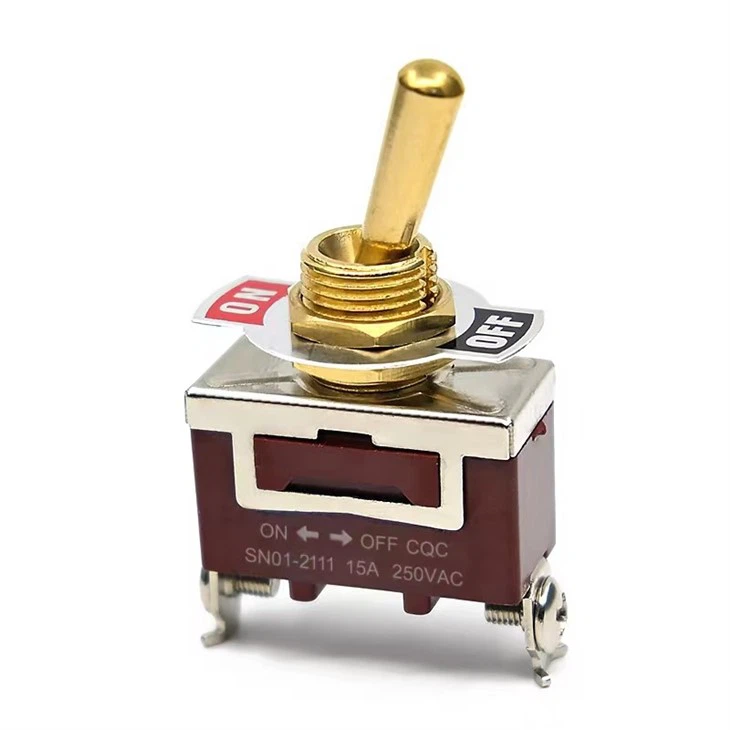
A toggle switch is actuated by a moving a lever back and forth to open or close an electrical circuit. Toggle switches offer a variety of switching functions - SPDT, SPST, DPDT, DPST and multiple actuator and bushing options. Our toggle switches also come in different sizes, from miniature PCB mount up to power rated panel mounted switches.
What Is Toggle Switch
A toggle switch is a mechanical switch that's commonly used to control the flow of electricity in electronic devices. It's characterized by the presence of a manually operated handle or lever which controls the flow of electrical current from the power supply to a device (such as a household appliance). If you want to know the specifications and prices of Toggle Switch, please contact us!
Advantages of Toggle Switch
Simple Operation: They're easy to understand and operate. Users can quickly flip the lever to turn a device on or off.
Durability: They're are often durable and can withstand a significant number of switching cycles. This makes them suitable for applications where frequent switching is required.
Cost-Effective: They're typically cost-effective to manufacture, making them a budget-friendly option for various applications.
Versatility: They come in various sizes and configurations, allowing for versatility in design and application. They are available in single-pole/single-throw (SPST), single-pole/double-throw (SPDT) and double-pole/double-throw (DPDT) configurations, among others.
Mechanical Feedback: The physical movement of the toggle lever provides users with a tactile feel, giving them feedback about the switch's state.
On-On Toggle Switches
On-on switches control two devices; each position of the switch activates one of the two. They are also known as changeover switches. A variant model - the On-(On) switch - combines a standard click position with a spring-loaded one which will snap back if not held in position.
Toggle Switch with Cover
These switches feature covers or caps which serve various functions. They can protect the tips of the internal lever mechanism, prevent the switch from being activated accidentally or click the switch off when closed.
Flat Toggle Switch
The term flat toggle switch may refer to switches with a flat-sided toggle, or switches in flat metal plates for vertical or horizontal fitting (for example on walls or the sides of machinery).
LED Toggle Switch
LED toggle switches include a light-emitting diode (LED), typically in the tip of the toggle, which indicates the status of the switch (i.e. on or off).
Mini Toggle Switches
These smaller toggle switches are also known as microswitches or snap action switches. They feature a sensitive spring-loaded toggle and respond to a small amount of applied force. The spring is energised by the inflow of current and this moves the contacts into place. Principally designed for lower currents, microswitches are cheap and widely used in both domestic and industrial equipment, often as sensors to detect the position of a component for safety reasons. For example, they can be used to ensure a door or hatch is shut before power is activated and to trigger a shutdown of the current when the door or latch is reopened.
On-Off Toggle Switches
This is the most basic toggle switch design, providing simple, binary on-off control for power supplies. On-off toggle switches usually make an audible clicking noise when moved from one position to the next. They are also known as positive on-off switches.
On-Off-On Toggle Switches
On-off-on toggle switches are variations of the on-on design. They add a third, neutral off position in the centre. In (on) off (on) switches, the off position is the default resting position and both on positions will click back to this once released.
Momentary Toggle Switches
The term momentary refers to switches fitted with a spring, which clicks the toggle back into its off state once released. Most toggle switches have a momentary variant, and this is indicated with brackets - e.g. (on)-off-(on).
Application of Toggle Switch


Home Automation and Lighting Control
Toggle switches are commonly used in home automation systems to control various lighting fixtures, appliances, and other devices. They provide a simple on/off control that is easy to operate.
Automotive Applications
Toggle switches are often used in automotive applications to control various functions such as headlights, turn signals, and windshield wipers. They are typically designed to be durable and withstand the harsh conditions of automotive use.
Industrial Machinery
Toggle switches are frequently used in industrial machinery to control various functions such as motors, pumps, and valves. They are often designed to be rugged and able to withstand high temperatures and vibrations.
Audio Equipment
Toggle switches are commonly used in audio equipment to control various functions such as power, volume, and tone. They are often designed to be high-quality and precision-made to ensure accurate sound performance.
Medical Equipment
Toggle switches are also used in medical equipment such as surgical instruments, MRI machines, and X-ray machines. They provide a reliable and easy-to-use control mechanism for various functions.
Aerospace and Military Applications
Toggle switches are frequently used in aerospace and military applications due to their durability and reliability. They are often designed to be shock-resistant and able to withstand extreme temperatures and environments.
Automotive
Toggle switches are used in vehicles for controlling lights, wipers, fans, and other electrical components. Their robust design and ease of use make them ideal for automotive applications.
Aerospace
In aircraft and spacecraft, toggle switches are used for controlling various systems such as lighting, communication devices, and navigation equipment. Their durability and ability to withstand harsh environments make them suitable for aerospace applications.
Industrial
Toggle switches are widely used in industrial settings for controlling machinery, motors, and other equipment. They provide a convenient way to start or stop processes and ensure safe operation.
How to Choose Toggle Switch
Type of Toggle Switch
There are several types of toggle switches available, including single-pole/single-throw (SPST), single-pole/double-throw (SPDT), and double-pole/double-throw (DPDT) switches. The choice of the type of toggle switch depends on the application in which it will be used. For instance, an SPST switch is ideal for simple on/off applications, while an SPDT or DPDT switch is used for more complex switching applications.
Current Rating
The current rating of the toggle switch is a critical factor to consider. It determines the amount of current that can pass through the switch without causing damage. If the current exceeds the switch's rating, it may cause the contacts to burn, solder melt, or the switch may fail. Therefore, it is important to choose a switch that has a current rating that meets or exceeds the amount of current required by the application.
Voltage Rating
The voltage rating is another important factor to consider when choosing a toggle switch. It determines the amount of voltage that the switch can handle without damage. Choosing a switch with a voltage rating that meets or exceeds the voltage requirements of the application is crucial. It is important to note that the voltage rating and current rating are independent of each other. Therefore, a switch with a high current rating may not necessarily have a high voltage rating.
Switching Capacity
Switching capacity is the maximum amount of power that the toggle switch can handle. It includes the voltage and current properties, as well as any resistive, inductive, or capacitive loads that may be present. It is important to calculate the switching capacity of the switch and compare it with the requirements of the application.
Switching Speed
The switching speed of the switch refers to the time it takes to change from one state to another. The switching speed may not be a crucial factor in simple on/off applications. However, it may be crucial in applications that require fast switching speeds, such as motor control systems or inverters. It is important to choose a toggle switch with a fast switching speed to minimize losses and minimize the stress on the switch contacts.
Actuator Type
The actuator type refers to the mechanism used to toggle the switch on or off. There are several types of actuator types available, including lever, bat, roller, and push-button. The choice of the actuator type depends on the application, the mounting location, and the operator's preference.
Mounting Style
Toggle switches are available in several mounting styles, including PCB mount, panel mount, and through-hole mount. The choice of the mounting style depends on the application, the mounting location, and the operator's preference.
How to Install a Toggle Switch
Disconnect all power from the device before beginning. As with nearly all types of electrical work, it's extremely important to ensure that there's no risk of electric shock before starting work on your device. Attempting to modify a "live" device is an easy way to seriously hurt yourself or cause a short circuit and permanently damage your device.
Remove the panel or housing from the device. Installing a toggle switch on a device requires you to gain access to the device's internal wiring, which usually means removing the device's exterior paneling or housing.
Measure the diameter of the switch bushing that will protrude through the panel. To accommodate your toggle switch, you'll usually need to create a suitably-sized and shaped hole in the paneling or housing of your device. Measure the dimensions of your switch bushing (the part of the switch in which the "lever" is seated) so that you'll know how large to make your hole.
Drill or cut a hole through the panel to fit your hole. Next, make a hole in the paneling of your device to fit your switch. For the most basic toggle switches with circular bushings, this will mean drilling with a bit slightly larger than the diameter of the switch bushing. For differently-shaped holes, you may need to use a jigsaw, sandpaper, and/or other tools.
Install the switch from the underside of the panel. Finally, put your switch in the hole you've just carved for it, passing through from the underside. Secure the toggle switch in place with its mount. This usually means installing the mount over the hole, passing the toggle switch through, and tightening it in place with a nut.
Defer to the instructions provided with your switch or your device. The types of devices onto which you might want to install a toggle switch will have electrical configurations that vary greatly. Thus, no single guide is likely to provide a one-size-fits-all solution. The steps in this section are meant to be taken as general guidelines for a simple on-off ((single pole, single throw or SPST) toggle switch. They should never supersede any instructions included with your toggle switch or the device into which you're installing it.
Cut the supply wire in your device. For your toggle switch to function as an on-off switch, you'll need to wire your toggle switch to the device's power supply. Use wire cutters to cut your device's supply wire in a location that best allows for routing either or both ends of the wire to the switch. Strip approximately 1⁄2 inch (1.3 cm) of insulation from each end of the wire using a wire stripper.
Add a pigtail if either end of the wire does not reach the switch. A pigtail is a short length of wire (usually about 6 inches (15 cm)) with both ends stripped. It can be connected to wires that aren't quite long enough to reach your toggle switch as a sort of "extender." Add a pigtail as follows:
Connect the supply wire to the toggle switch. At this point, you've made a break in the device's supply wire, you'll need to add your toggle switch in the middle of the break so that it can regulate the flow of electricity through the circuit.
Test your switch. When your toggle switch is wired properly, carefully reconnect the device's power supply and test the function of the toggle switch.
Select a switch with the appropriate number of "poles" and "throws" for your purpose. In electrical terminology, a toggle switch can have one or more "poles" and "throws." Apole refers to the number of circuits controlled by the switch-usually, this is the number of outwardly-visible "levers" on the switch. A throw refers to the number of positions a switch has. Usually, for simple on-off capability, you'll want an SPST switch.
Choose a switch rated above the maximum current (in amps) that will flow through the switch. Different electrical devices require different amounts of current to power them. When searching for switches, make sure the contact rating of the switch you select is equal to (or greater than) the circuit current you plan for it to regulate.
Select a switch with the right type of electrical connections for your project. Your toggle switch is useless if it can't connect to the device it's supposed to operate. Be sure to pick a switch that's compatible with the electrical connections inside your device.
Pick a suitable mount. If your device comes with spaces specifically designed to accommodate toggle switches, you may be able to get away without having to make any extraneous modifications to your device. However, the types of devices in which toggle switches are often installed usually don't. Thus, you should usually expect to need to drill a hole for the switch and to install a mount to seat the switch in.
Certifications

Frequently Asked Questions
Q: What is a toggle switch used for?
Q: What is the principle of toggle switch?
Q: What is the purpose of toggle button?
Q: Can you use a toggle switch as a light switch?
Q: What is a practical application of a toggle switch?
Q: How many types of toggle switches are there?
Q: Where do you use a toggle switch?
Q: Which is better, a toggle or a rocker switch?
Q: What is a three way toggle switch used for?
Q: What are the applications of toggle switch?
Q: What is the direction of a toggle switch?
Q: How many volts can a toggle switch handle?
Q: Why do toggle switches fail?
Q: Can you replace a toggle switch with a rocker switch?
Q: What is a toggle light switch?
We're professional toggle switch manufacturers and suppliers in China, providing high quality customized products with low price. We warmly welcome you to wholesale cheap toggle switch in stock here from our factory. For quotation and free sample, contact us now.
Dpdt Rocker Switch, Micro Switch TM 1702 With Short Handle, 35x25mm LED Illuminated Rocker Switch